


September 7th, 2018
7 Sept 2018 · page 832 of 1306
Back at it.
Cast: George Knott, Vincent Knott
Comments (81)
Events

ThoughtBubble
14 Nov 2026 – 15 Nov 2026
Harrogate Convention Centre
Manchester Megacon
31 Jul 2027 – 1 Aug 2027
Manchester Central





The young guy has such a cute face.
Just so you know, whenever you put flyers in a panel I study them looking for either a fun reference or foreshadowing.
Guessing it's a suffrage movement? When did women get the vote in England?
1918, just after WW1, for women who owned over a specific amount of wealth. But 10 years later for all women. the Suffrage movement was very active for decades prior to this though, so doesn't date the comic too much.
1918, but the Widdershins 'verse is generally more progressive than reality (e.g. the complete lack of racism against Sid and Mal, or how most people are okay with homosexuality), so I'd be surprised if female suffrage wasn't already a thing (Councillor Fairburn from the second book shows that there are already women in important political positions).
Women can vote in this world, yup
Actually according to Google the Sufferage Movement started up in 1848, but again this seems like a moot point when we have both female police officers and women holding governmental office in the Whiddershins-verse. Seems kind of stupid to have both of the aforementioned and yet women aren't allowed to vote don't you think?
Well this lead me down a bit of a rabbit hole of the history of women elected officers, and I wanted to share the highlights. [Note that given Kate's none of this is particularly relevant to Widdershins, but I still though it was worth sharing for stories!]
Nineteenth century women mayors in the US mostly came from Kansas (there was also one in Oregon and one in Idaho in the 1890s). The first women to actually serve as mayor, [Susanna M. Salter](https://en.wikipedia.org/wiki/Susanna_M._Salter "https://en.wikipedia.org/wiki/Susanna_M._Salter"), was entered on the ballot of Argonia, KS in 1887 as a joke. But when women temperance activists and republicans rallied to her name she agreed to serve, and apparently did a good job. The next year the town of Oskaloosa, KS elected a women mayor and an all-women city council, and probably not as a joke because they were all re-elected in 1888.
The first women mayor in the British Empire was Elizabeth Yates "https://en.wikipedia.org/wiki/Elizabeth_Yates_(mayor)") of Onehunga, New Zealand. She was elected in 1983, in the first election to occur after New Zealand granted women the right to vote.
In that same year, Colorado elected three women to its state legislature after becoming the first state to pass women sufffrage by popular vote. (Wyoming granted women suffrage in 1869 while it was still a territory, and I think some other territories or state gave women partial or complete suffrage by other means but I haven't tracked down all the details).
The first woman mayor in the UK itself was [ Elizabeth Garrett Anderson](https://en.wikipedia.org/wiki/Elizabeth_Garrett_Anderson "https://en.wikipedia.org/wiki/Elizabeth_Garrett_Anderson"), in 1908.
Women governors was more of a gradual thing -- at first, you women filling in for elected or outgoing govenors in extenuating circumstances (Carolyn Shelton--the governor's secretary-- in Oregon in 1909 for a single weekend; Soledad Chávez de Chacón --Secretary of State for New Mexico-- for two weeks in 1924). Nellie Ross won a special election to replace her husband, the late Governor of Wyoming, in 1924. The first women to win a general election for governor was Miriam Ferguson of Texas, who won in 1925, but who made it very clear that she was running on behalf of her husband, who had been impeached as Texas' governor in 1917 ("Two governors for the price of one!")
Lot's of stories on the National legislature level too, of course, but I want to focus on [Jeannette Rankin](https://en.wikipedia.org/wiki/Jeannette_Rankin "https://en.wikipedia.org/wiki/Jeannette_Rankin"), who led the successful women's suffrage movement in Montana and was elected the the US House of Representatives in 1916. She was elected to the House of Reps again in 1940, where as a committed pacifist she was the ONLY congress member (House of Reps or Senate) to vote against declaring war Japan after Pearl Harbor, and had to flee a mob on the way out of the Capitol... talk about balls!
I have the head-canon that this was perhaps a prudent response to the fact that you can't recognize mages on sight in the Widdershins universe, and that magical ability isn't restricted to specific demographic groups.
An interesting historical note is that all of the Suffragettes' sound and fury accomplished precisely nothing. It was the demands and social upheaval of total war (i.e. WW1) that made it happen. Something to take note of if you have a mind to be a reformer yourself.
That's much too simplistic. The arguments and organizations were in place before 1918 and WW1 catalyzed the movement and the interest in its goals in many ways, finally acknowledging the validity of their point.
Now you should really back up the point you are making.
Now if you have any good books to recommend about either of these things, this is a topic I'd be absolutely fascinated to read a lot about.
This is more my wife's bailiwick so I will ask her and come back to this.
I freely admit that this is not my field of history, so if you're asking for sources I have nothing to offer. If I had a day in a library I'm sure I could come up with some. However, I have heard a great deal about the issue incidentally, one might say, from my studies into WW1 proper.
My point is that it was the social changes accompanying the War that gave the Suffragettes the leverage they needed to actually accomplish their goal. (Specifically the new importance of women in war industry.) Violence and social protest in the prior decades did not accomplish anything meaningful. (And lest we forget, a small but visible minority of these women were disturbingly violent.)
And as ever, if the common narrative has it wrong I would love to read the sources and accounts.
Finally, I'm sure there's several good books on the subject, OB. My personal favorite case study in reform is the Prohibition movement in America. For that, read "Last Call" by Daniel Okrent.
Well I think then you could have made a better comment in the first place. Something more like:
"While the British Suffrage movement existed since the mid 19th century, the gains they received in 1918 resulted from catalysts during the WW1 which built upon the established groundwork in place. Factors such as women's employment in war industries during that war built upon the foundations in place to finally drove this first stage of women's voting home."
Or something like that.
I think a person can express a valid point without employing an arrogant tone.
As a trained historian, I share your evident frustration with the condensation of complex historical events into simple narrative. However, I have long made peace with the fact that this is often necessary for the sake of brevity or simply to allow non-historians to grasp the salient points of an example. As long as the simplification is correct in its essentials, I believe no harm is done.
My actual point, however, remains that extremism does not produce profound changes. Fundamental shifts in society or popular thinking produce profound changes. Or as I said before (simply, but I would say accurately), nothing changes until normal people start getting involved. I believe I said that with an acceptable level of clarity in my initial post, given that I am at work and writing between meetings.
Just to preemptively say, let's everyone keep this one civil on both sides, please and thank you.
I always do my best to adhere to that rule. And had to take some of my commentors to task for that earlier today. [http://qr.ae/TUNaWD](http://qr.ae/TUNaWD "http://qr.ae/TUNaWD")
"However, I have long made peace with the fact that this is often
necessary for the sake of brevity or simply to allow non-historians to
grasp the salient points of an example. As long as the simplification is
correct in its essentials, I believe no harm is done."
I believe much the same hence why I offered an alternative that adhered to the essentials and the depth wile condensing to only a couple sentences.
I really just think you were too brief in this initially.
I'm not very familiar with the history of women's suffrage in the UK, but for the US this is false. (I can't tell from context if these sentences are discussing the UK specifically, sorry if I've interpreted them too broadly.) National womens suffrage didn't occur in the US until the passage of the 19th Amendment in 1920, but state and local women's suffrage began to happen in various states and territories starting shortly after the American Civil War (that is, late 1860s). See this timeline for details: [https://en.wikipedia.org/wi...](https://en.wikipedia.org/wiki/Timeline_of_women%27s_suffrage_in_the_United_States "https://en.wikipedia.org/wiki/Timeline_of_women%27s_suffrage_in_the_United_States")
Just as one example, Jeanette Rankin led the movement for women's suffrage in Montana, which successfully passed in 1914, and was elected to represent Montana in the US House of Representatives in 1916 -- a year before the US entered WWI.
To be very, VERY brief, women's suffrage in the US gained its necessary leverage from the Prohibition movement. The male prohibitionists wanted to be able to flood the polls with new anti-liquor voters. It worked. For full details, I refer you to "Last Call" by Daniel Okrent, which I think I mentioned earlier in the thread. (American Prohibitionism is the single best case study in reformism that I know of, both in terms of how to do it and how not to do it.)
Anyway, IIRC American suffragists were not prone to physical violence as British suffragists tended to be. If my recollection is wrong, I'd love to hear about it.
It would be a lovely thought to believe that progress in social equality was simply an inevitability, but if you don't do the legwork putting the idea that social equality should be the natural way of the universe in people's heads, people will never "naturally come to that conclusion" on their own.
[Sorry for the wall of text. Started writing and got sidetracked a few times. So reader beware...]
The "Great War" changed a lot of things, some which we don't even think much about today. Looking back it's no mystery that women's rights movements got a boost by the war. During the war women had been recruited to work jobs that had traditionally been male dominated if not exclusively had male workers. Once the war ended and the men came back from the battlefields these women were told they were no longer needed. A lot of these women didn't want to go back to being second class citizens now that they had shown that they could actually do a lot of the same work as the men.
So while the suffragettes might have worked on changing society for more than 50 years, it was the end of the war that really gave them a chance to make their voices heard. They now had an audience consisting of women who had worked in the factories and on the fields, and the men who had to admit that women actually could do a lot the the same work. This didn't mean that all men welcommed that development, quite the opposite in fact. Without either the suffragettes or the war, as horrible as it was, I doubt this change would have come as early as it did, if at all.
War can change a lot of things, some are big things like womens rights, others we don't really think about. One such thing is men's beards. Up until "The War" beards were a lot more common than they ever has been again. The reason was the chemical warfare that for the first time was used in a large scale on the battlefields. Gas masks were quickly developed and distributed to troops, but in order for them to work effectively the soldiers had to shave off any beard. After the war a smooth shaved face was a sign of a soldier who had been to the front while a large beard conveyed the message that the man hadn't fought in the war. This caused young men to keep shaving, even if they were to young to have been a soldier. All in all it changed the way people looked at bearded men, especially the young ones.
Oh jeez, just came back too look at this. Did I almost unintentionally kick a barrel of gunpowder down a flight of stairs? I love history and all it's weirdness as much as the next guy, but looks a tad thing things almost got messy.
don't worry about it, can't predict where these things will end up!
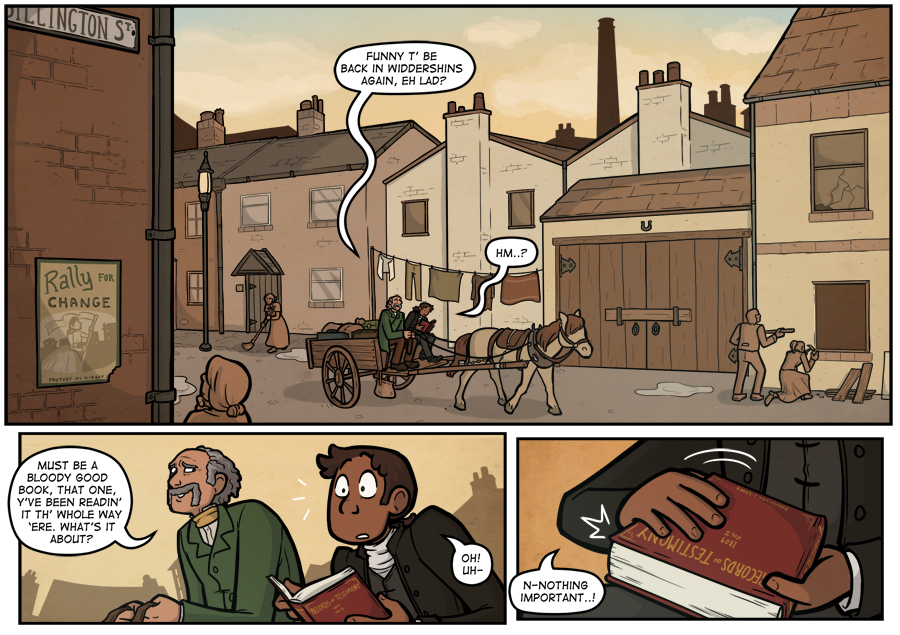
Um, if you recall the topic of this chapter as seen on the cover page and the fact that the poster says "protest by gibbet", you might expect it to be about a, well, different cause.
Is that what it says? Looking at it on my phone I couldn't make out the bottom words.
I'm thinking it may be something to do with the platform Councillor Fairbairn tried to get elected mayor on? Maybe someone decided to revive the movement in the wake of the destruction cased by the deadly sins
I saw that stick and thought it was a protest against the metric system.
So Vincent here will be our storyline protagonist.
Loving the vagueness of that poster. Rally for change indeed.
Have you seen much current advertising?
I see so many billboards and flyers with a factoid in the void, or the name of a company with no information or contact details, or slogans with no context...
Can anyone make out the text on the bottom of the poster? Protest (at?) (????)
Neat to see new characters :)
I think it says “...at Gibbet [torn-off corner]”. According to the map, the jail is on Gibbet Street, so that makes sense.
Protest at gibbet, yeah. In case you're not familiar with the meaning of this word as a common noun: [https://en.wiktionary.org/w...](https://en.wiktionary.org/wiki/gibbet "https://en.wiktionary.org/wiki/gibbet")
Yes, I know it.
Sorry, force of habit from my job (teaching English as a foreign language) XP
A lawyer or accountant. An otherwise boring profession. Funny how many boringly-employed people end up in mortal danger here...
"Rally for change"... Suffragettes, maybe?
In this utopian AU women already have the vote (VOG). Perhaps people have finally realised that Ms Fairbairn was right after all and it is time to ban magic.
But given the subject of this chapter I'm guessing they want to ban the death penalty.
Maybe, a movement for abolition of the death penalty, hmm? ;)
Edit: I'm ready to swear there wasn't this idea in the comment above when I was writing this. :))
Perhaps it's a campaign led by Captain Barber to end all this radical nonsense and get dangerous criminals decently hanged.
And yes, I did edit my post two minutes after I posted it.
Lol. I did start to think about if what happened with Wrath last chapter had any bearing on this protest.
I like this, especially as his book on the cover was about the subject.
Fairbairn accomplished nothing except lots of notoriety. There was no meaningful push towards Universal Suffrage until women took over most civilian jobs during WW1. That gave the political leverage.
Or to look at it another way, no meaningful change happens until ordinary people get involved. Cranks make great headlines, but don't accomplish much.
Speaking of Fairbairn, my wild alternate theory is that the change the poster is pushing for is some kind magical reform after the events of the last chapter.
I'm confused... are you referring to the real world in your comment, or to the fictional state of affairs in-universe?
I think I might be confusing the in-universe character for the Suffragettes' leader, whose name everyone always cites but I can never ever remember.
It's Friday, and as you know I'm prone to confusion at the best of times. Sorry. :P
Okay, I was getting kinda confused there because there is literally nothing to do with suffrage going on in this comic right now or ever
Yeah, I alternate between profound insight (or a reasonable facsimile thereof) and complete idiocy on almost a moment-to-moment basis. Never feel bad about ignoring me. :P
Lol I guess you've managed to confuse a number of people who are defaulting to their knowledge of real-world history to analyze what they're seeing 😜
I am almost certain that this was not my fault.
Haha no problem. Fairbairn was Ben Thackerey's evil former boss from chapter two. She was a corrupt politician campaigning for reform on the use of magic. Can't say I think much of her methods for stirring up popular support for social campaigns.
Her methods were straight-up evil. Literally evil, considering she was using a deadly sin. There's a lot of that school of politics going around in America at the moment; more than average, I mean.
Oh yeah, for sure! I guess I was thinking of the "manufactured crisis" part more than the "fueled by deadly sin" part, but both are definitely bad...
Well, given the events of the last year, and especially the last couple of days, I'd say that the abolition of this dangerous magic as proposed by Ms Fairbairn will definitely get political leverage and I think that people will be more than ready to get involved to bring about meaningful change.
Looks like the town is cleaning itself up/repairing the damage after the chaos caused by the Deadlies. I can't remember where the map is, does anyone with access to it able to find out where (B?)illington street is in context to where the Deadlies were going down?
I can't find it on the map, which only seems to show the names of main roads. The industrial chimneystacks in the background, however, make me think we're in the general area where Sloth was found.
I wonder if it's by Gibbet Street... That's a part of the map not quite showing, and Wrath was on the rampage there right? Assuming this arc does take place after the last one...
Don't go to Widdershins ! Tis a silly place.
It's only a model.
OK, on a scale of importance, how important is this "nothing important"?
A) Quite important. B) Fairly important. C) Important or D) Bloody important.
I'd guess D.
Definitely D.
E) The new final boss/plot/plot twist/plot hook/etc.
According to the tags, the older man is George Knott, so he must be Vincent's... father? Uncle?
Quite possibly.. Maybe grandfather?
That would work too, especially since grandparent/grandchild relationships have been a big thing in the comic already.
I really love the colors on this page! I'm working on figuring out color schemes in my own art, and I really like soft and warm the colors in this image feel, with our two main characters standing out but still being part of the world.
Yeah, and this color of sky contrasts with ones in the last chapter, being peaceful and pleasant for eyes.
Yes, a nice ordinary sky with nice ordinary clouds!
So, Kate, this is twice a week, while the gocomics is showing your work five days a week, and catching up very quickly. What is your plan? I'm curious...
the agreement i have with them is to do the backlog at 5 days a week til it's caught up, then it'll just follow the update schedule from here.
Still, it will get 47 weeks till the end of "Curtain Call", and then, some months more for catching up this chapter. :)
I'm sure we'll find out soon enough, but does this take place before or after our previous disaster family did their story? The book says "1809" but it could be a really old book.
What I see so far: Vincent is studying a law manual (dated 1809?), volume 1. He has been in Widdershins before. The cart driver has an accent, & the same last name as Vincent but doesn't know what the "lad" is reading. It isn't a passenger carriage, it is a cart for carrying things. And life goes on in Widdershins (laundry, building repairs). Probably close to sunset based on the sky color.
My current theory (which may be immediately disproved on the next page) is that Vincent and George are relatives of some kind and are originally from Widdershins, but haven't lived here for some time. Vincent, in the process of getting his education, lost (or at least reduced) the Yorkshire accent that George still has.
Intriguing! The townspeople cleaning up damage implies this takes place just after the Deadly incident, but the sepia tones could imply this is more of a prequel story. I'm looking forward to see where this goes!
Kate hasn't used sepia for prequels before, though - think of the majority of Find the Lady. I think the color scheme is more to do with the time of day/lighting.
When I was growing up, this (Vincent) was me on every single road trip my family made.
Heck, I'd still do it, but I'm the one driving now....
Hmmm. When is this?
I do hope that Vincent has a cousin named Wyoming Knott. I mean, seriously, Kate. You know you want to, so Why Not?