



November 6th, 2018
6 Nov 2018 · page 848 of 1306
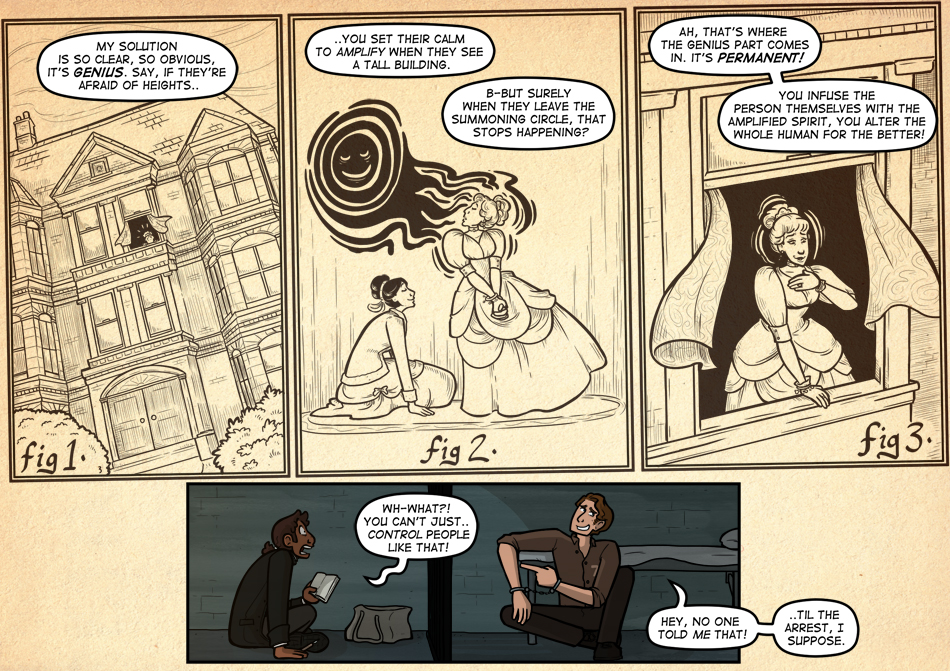
No way could this ever be misused.
Cast: Vincent Knott, Will Sharpe
Comments (79)
Events

ThoughtBubble
14 Nov 2026 – 15 Nov 2026
Harrogate Convention Centre
Manchester Megacon
31 Jul 2027 – 1 Aug 2027
Manchester Central





Seems perfectly reasonable to me.
This obviously has no moral or ethical implications at all.
Of course not! Just think of the opportunities! xP
I feel like that specific example might lead to accidental falling off buildings if the added calm overpowers the rational fear of falling.
And also people could totally misuse this.
No prob. Just add a spirit of caution to their soul and they'll stop jumping off tall ledges. Why set your limit on one add-on possession. There's always room for more. Probably.
Thoughtfully. Well... if one does that a) with absolute agreement of a full-informed patient; b) in the obvious cases like phobias; c) for a limited time and with the option of reversing that at any moment... well, maybe, it would be an acceptable procedure.
However, it seems there isn't a course of ethics in the Widdershins University.
The last line seems to indicate that he skipped or slept through the lecture about the illegality of this procedure. Although to be fair, a lot of university lectures never state their facts clearly and leave it up to the student to study and understand the material.
Perhaps that's why Dr Flack came to visit. It had been in her course.
Now I see with my eyes of mind the black-framed portrait of Sharpe hanging in the University and the writing in large letters under it, "It will come to everyone who skips their lectures!" :)
(A) is obvious. Unless they're, you know, mental patients that need others to make decisions for them.
(B) This is going overboard for simple phobias unless they're crippling ones. I'd rather get the chills when crossing shaky bridges than have some hack rewrite my personality.
(C) Why? Is your personality something you like changing every other week?
This is probably how Desire in human form came about, right? Not a good precedent.
(A) > Unless they're, you know, mental patients that need others to make decisions for them.
There is too a wide space for misusing by others, I would say.
(B) I tend to agree with your position. Put aside really serious phobias, I thought rather about the situations like (in the real-life terms), "A rich person must fly by plane and have a strong fear of flights". They get a procedure like that, fly calmly, after the flight it get reverted.
Another thing I thought about is clinical depression and "phasmia-analogue" of antidepressant treatment.
(C) > Why? Is your personality something you like changing every other week?
No, it is rather a matter of "If I allow someone tampering with my personality, I must have 100% garantee that this process is reversible". Because there are mistakes and bad/unexpected effects of all kinds to happen. And I may just change my decision. :)
Of course, we even don't know yet if this process is reversible, actually. If it isn't, I am out of this.
About changing personality every other week, well... persons' phobias/depression are part of their personality, I think, like chronic diseases are part of our bodies. But one can decide to rid of these parts and turn to medics for help in that. The problem is not so severe cases, I guess. I think about anxiety-ridden person who lives in constant fear and worrying and wants to be infused with Serenity just to get the experience of the different life. He got the week of the different life and now he wants to live like this forever. And at that moment, I believe, the therapist should say to him, "Great! For this, you should take our course of slow phasmia-therapy!", not just prolong his infusion with Serenity. For this reason, I see a temporary nature of infusion as obligatory.
So, I guess this would make Will's Hack-O-Matic Phasmia-Psychology equivalent to psychiatric medication? Manage the symptoms while the underlying cause can be addressed more properly. (Assuming, of course, the process is indeed reversible.)
As for using it for as something as broad-ranging as depression, well, that's a bit trickier since depression is something that pervades one's life more broadly.
Except... points at the opioid epidemic
Methinks this version of the British Empire rather lacks the checks and balances to stop the misuse of this. See also the con otherwise known as the "therapeutic use of leucotomy" (labotomies for everybody! including hysterical women with women's troubles!).
In fact, the general use of cocaine and laudanum (opium) in patent medicines was one of the driving forces behind the Pure Food and rug Act of 1906 here in the US.
Good point. Should have said "the waves of the still-continuing opioid epidemics and the companies and 'science' which routinely push them".
True. And people get addicted to Xanax, which would be the closest analogue to his example scenario.
Yeah, he's pursuing this way too recklessly.
Maybe the technique can eventually be made reversible but Sharpe hadn't thought that far ahead. If his paper does not include any method for reversing the process, that both explains the authorities' drastic reaction, and gives our characters a potential way out.
What does consent/agreement mean when you have the ability to ramp up their Compliance?
Presumably consent prior to the procedure taking place.
This is actually a very fundamental point: if even the concept of consent/compliance are treated as forms of "spirits" that has the potential to be altered or manipulated, it means that in this universe, the very notion of "humanity" and "free will" is drastically different from ours. (which, I mean, it obviously is......)
Yeah, I think the Human Subject Committee might have a bit to say about the ethical aspects of this technique. And I'm quite sure that the University's PR group would have a lot to say about it, not much of that nice...
OTOH, yes, viewed as therapy, this could well pass muster, given patient consent. I mean, there is that whole "Are you the same person if your mind is completely altered, and, if not, can you reasonably give consent?" question, but that's something for the philosophers to waste their time thinking about. We need to fix things in a hurry.
Does Widdershins have Human Subject Committees? In the real world they did not start forming until the mid 20th century, but we know Widdershins is more progressive (in some ways) than the real world was at the same time.
Hate to say it, but you probably need to have the medical atrocities first before you have people setting up organizations to prevent future medical atrocities. Also: the Widdershins universe seems to have somewhat better rule-of-thumb therapy, but I don't know if they really have a good theory of mind yet. That takes time to develop.
Unfortunately I suspect that you are correct. Depressingly that's true of most safety regulations, not just medical atrocities. Here in the US we needed the Triangle Shirtwaist Factory fire before we saw the need for a law prohibiting chaining the fire exits closed.
As long as consent was obtained beforehand - and recorded with a witness and a very good contract - then it should not be a problem, any long term effects not-withstanding.
As far as whether the person after is the same or not, it matters little, its the person before we need to get permision from, thats the one who was mentally operated on. If the person after disagrees, well thats what you have the signed contract for, and maybe a way to reverse it.
I'm guessing he skipped a few steps though....
I can't imagine the consultant lawyers and accountants (whatever their individual fields) being all that thrilled to find this mess on their plates, either.
Or maybe there is but Sharpe ignored it. My degree program had a required ethics course, or as my fellow students called it, "naptime".
I'm not sure the technique is a real issue. Or reversibility. It's another combination that's deadly. One we're building in the real world, too.
We use hypnosis in therapy all the time. Amplifying someone's calm in a certain situation? That isn't much different from techniques used routinely in the real world, without magic involved. They often work, and you can even find videos of stage magicians doing fast phobia removal on TV talent shows.
Does that shift change your personality? No. I'd have to amplify your calm all the time and across the board. About that... how many people take Prozac and related drugs these days? On a much more benign note, how about CBD? You see where I'm going with this.
"I must have 100% garantee that this process is reversible"
In the comic's case, if it's magic then it's much easier to undo by its very nature. But people do willing permanent personality changes all the time, with others' help. Martial arts, for instance. Religious conversions and their analogues (nightmare fuel: imagine a friend who becomes an atheist, adopts a vegan diet, AND starts attending crossfit - all at once. Bonus quiz: which would they tell you about first?). Etc. So I don't think that's quite the issue.
I'd say the real focus here is the potential for easy AND unwilling manipulation. That's the terrible combination. And that's why reversibility becomes so important.
Note that unwilling manipulation is possible for us today using tools like NLP and hypnosis. I've seen it happen to people I know, and it was hell to fix. It's easier and worse if there are really no ethics, and the larger "package" includes stuff like sleep deprivation, deliberate trauma, etc. The thing is that unlike magic (where you can first boost Compliance, as Thomas Clarke points out), what I've described in real life varies from "quite involved and difficult" to "yeah, good luck with that guy."
At least, it was BEFORE we instantiated a social media panopticon with connected 24/7 health monitoring devices...
So, the word "possession" never crossed his mind even once? O~K. <_<
Hoooooooly flargl... I can imagine a few dictators who would be VERY interested in getting their hands in this kind of stuff.
There are real-life techniques with similar effects, and they have been used by dictators, but they're too labour-intensive to apply on a large scale.
I mean, this is basically hypnotherapy.
Or the CIA, for that matter. I've got a feeling MK-ULTRA is going to turn out somewhat less unsuccessfully in this universe. And we're not even gonna get LSD out of it.
One wonders if Sharpe used to suffer from extreme lack of self-confidence, until he tried this technique out on himself one day and imbued himself with bravado or something.
Or pride.
interesting thought. have you seen the movie Office Space? something like that happens, with hypnosis I think
Apart from the permanence, isn't this equivalent to treatment with psychoactive drugs?
Psychoactive drugs cannot currently be uplifted into full sapience and then enslaved to operate at 12/10ths of capacity for decades at a time.
Gotta be honest here, if I trusted the person doing this, I can think of a few things I'd like to tweak about myself. And there are ways to verify the trustworthiness of professionals - so, yes, if this were a thing, I'd probably do it. More intelligence and creativity, less procrastination.
I can see where, on a societal scale, it could be problematic - lots of people running around with their seductiveness/glamor turned up to 11, not to mention boldness or self-interest. It'd be like everyone suddenly got rich and famous, and then had to live with each other. So it's probably good that this isn't a thing in this world.
But the main problems I see come from people being more themselves, not from people taking advantage of others. There are already lots and lots of ways to do that; one more wouldn't make much difference.
> More intelligence and creativity, less procrastination.
It's one of the most acceptable options, I would say. I imagine a good, well-intentional person saying "I want to be braver/kinder/more loving person". Well, it seems as there is nothing wrong about these wishes, but... I can easily imagine how it may go wrong or doesn't work, but the real problem is it may work, in theory.
Maybe, Lewis's The Abolition of Man made too strong impression on me. :)
The final stage is come when Man by eugenics, by pre-natal conditioning, and by an education and propaganda based on a perfect applied psychology, has obtained full control over himself. [...] For the power of Man to make himself what he pleases means, as we have seen, the power of some men to make other men what they please. [...] They know how to produce conscience and decide what kind of conscience they will produce. [...] Nor are their subjects necessarily unhappy men. They are not men at all: they are artefacts. Man’s final conquest has proved to be the abolition of Man.
And if you didn't trust the person doing it, well, there's a cure for that now. It's a win-win.
Methinks Ethics 101 is in order.
Just a bit. And a quick lesson on Is-Ought as well as "without fully informed consent, precautions and follow-ups, no you bloody don't". <_<
So, let's say we want to quickly create, I don't know, a bunch of avatars of the seven heavenly virtues. Wouldn't it be wonderful to find criminals who clearly lack the essential qualities these represent and wish to be rehabilitated in a short time. Why not simply bind the missing virtues to the people in question, and then let them experience those feelings all the time. Even let those feelings motivate them completely!
Wow! A perfect mechanism for creating better, more honest, more perfect people! Who knows, maybe you could make that kind of mental adjustment be required, just like spectacles are! Think about it: a world where everyone is honest, humble, chaste (ok, maybe not that one)... Think about how much better a world that would be!
Of course, there are some drawbacks. I mean, the whole loss of free will business isn't all that big a deal: we give that up to be part of society. But how are you going to find enough copies of the virtues to go around -- they sure seem in short supply around here, anyway.
Maybe if you just used...I don't know...other spirits? Yeah, that fits the bill
What could possibly go wrong?
Well, Sharpe describes that process as amplifying of the patient's own spirit. Maybe, hardened criminals haven't any drop of a virtue (honesty, for example) in them? Oh well, what a difficult phylosophical question... who was right, Rousseau or Hobbes?
Hume and Popper. ;P
And a problem of quite a different kind: wizards are supposed to be paid a lot of money for these procedures, who will pay for the total improvement of humankind? Or we should begin with making wizards themselves more selfless?
Ah, so it's not killing spirits: it's forcing spirits into existence, then enslaving them to operate without supervision for as long as the human host is functional.
On the bright side, at least this indicates that Widdershin magicians don't really think of spirits as being things.
Assuming that is part of the reason the board comdemed him. It could be mainly due to him perminately altering people's minds.
As they used to say in my old line of work: "embrace the healing power of 'and.'" :)
Btw, there is a matter of offerings. Does this procedure require some additional offering to spirit? Or it is "pay once, works for ever"?
cringe cringe cringe I don't like where this is goiinnnnnng
I'm curious to see how this part of Will's character arc plays out. Will Vincent (or anyone else) ever be able to convince him that this is a really bad idea?
Does the argument "They gonna hang you for that, so it must be a VERY bad idea" sound as convincing one?
It doesn’t seem to have convinced him so far, given the whole “I’m a misunderstood genius” line he’s been giving Vincent.
I dont think that alone is a good reason. A while ago (not entierly sure the exsact time) a man got killed for making it so the bible was more avalible to the public. I understand that this is a different scenario but just because they want to kill him for his idea does not necessarily make that idea wrong
I thought he found a way to carry the circle, not a Insulin pump full of Ritalin.
Will Sharpe ain't the sharpest?
So... a number of folks here have speculated that this was already done to Sharpe to boost his self-confidence. If so, I wonder how much of his work was done before that happened, and how much was done after. (Perhaps it even happened to him by accident, and this was what gave him the idea to try it on other people?)
The reason I'm wondering this: If he was already under the influence of this procedure before he did most of his "crimes against magic", then how responsible was he for his actions? If part of the reason that this is such a terrible thing is because it affects your free will and alters your decision making process, then should he really be held culpable for crimes that he committed while he wasn't in proper control of his own mind?
(I'm just trying to throw Vincent a rope here, so to speak.)
The rope is the problem! He doesn't want the rope!
This could help persons with emotional disorders to deal with reality better.
Can this be done for an entire culture that has gone insane? Like a Supreme Court decision?
I wonder if he actually did this or if he just wrote about it?
I'm going to be real honest, I don't really see much of a problem with this in theory. Tacking new bits onto your soul to change how you behave and counteract negative or damaging traits seems like a really useful technique to have in one's back pocket. Patient suffering from some manner of personality or emotional disorder? Tack some serenity onto them to help them bring themselves back to 'neutral'. Schizophrenia or hallucinations? tack some skepticism onto them so they can more easily distinguish between what's in their heads and what's reality.
In concept I don't think writing this paper would have earned Vincent the noose, people write speculative papers all the time about potentially ethics-breaching things and don't get killed. I'd imagine they probably took issue with whatever research he conducted to back his theories and hypotheses... unless people got so spooked by the concept that they universally decided it was better to kill him off.
Pretty sure you're right, it wasn't just a speculative paper. His crime was that he made it work and spelled out how he did it, so others could do it too. Chances are he used himself as a test subject. And he didn't bother to work out how to reverse the effect. If that's what happened, I can see the authorities panicking and deciding to suppress the whole idea.
Let the beggar swing, sez i.
Freaking hell. No wonder everybody is terrified and/or pissed enough to give this guy the noose. What are the side effects? If I'm bound to happiness, am I still capable of mourning when a family member dies? Does that emotional state become "normal" forcing me to seek out greater extremes of emotion to maintain the feel? If a problem develops, can the emotion be unbound? Can an emotion be bound against someone's will? I can see some potential positive uses (treating depression, maybe?) but massive abuse potential. Also... how thoroughly did he test his theory, and were the participants aware of what they were getting into? Because if he's delving into literal mind control in the practical sense instead of just the theory, I might be okay with him getting the noose (as much as that would distress our poor protagonist).
"am I still capable of mourning when a family member dies?" Why would you want to?
"forcing me to seek out greater extremes of emotion to maintain the feel?" Well, no, if you're constantly happy, you're happy, no need to try and get more happy.
""am I still capable of mourning when a family member dies?" Why would you want to?"
Because not mourning a real loss would make you less than a complete human. This "solution" is like amputation of an emotion. You wouldn't want a perfectly good leg replaced with a prosthetic because of a broken toe, would you? no matter how temporarily painful it was. You'd only go for it if your leg became, say, gangrenous and was threatening your life.
"Because not mourning a real loss would make you less than a complete human." Why do you think that?
The question deserves a serious answer. Why do I think that?
Because I can look back on a long life. Things look rather different from this perspective. I can now see that mourning my dead, coping with grief, continuing to sort all that out in my mind throughout my life, was valuable. It made me a better person, less selfish. Less afraid, too, of my own death.
Can it go wrong in toxic ways? Oh yes. I saw it happen. All the same, the state of understanding that you can reach by deliberate choice is deep, rich, and complex. It is better than happiness -- it is wisdom. To the extent that I have it, it is very much worth having. if magic could pull Sharpe's trick off in real life, there would be cases where it was the only answer. I would still feel sorry for those who had to be stuck in a simple imposed emotion, unable to travel the path to reconciling with their dead.
If you're always happy, does happiness have any meaning? If you can't feel sad, can you even relate to other people? Hell, I'd be genuinely worried for my sanity if my emotional state was disconnected from my reality. I don't want to feel sad, but I accept sadness as sometimes necessary and appropriate. I want to feel happy, but at the same time I recognize that happiness is meaningless without contrast.
"If you're always happy, does happiness have any meaning?" Yes, because you're happy.
"If you can't feel sad, can you even relate to other people?" That might be a point, but being happy doesn't make you ignorant or forget the time before you were happy.
" I accept sadness as sometimes necessary and appropriate" Only because you have to.
The testing is the part that concerns me as well i see no reason for him to be killed over writing a theoretical paper even if it is moraly dubious. But if he tested it especially if it was without consent then i start to see the problem
Alright Sharpe, you just went from "dashing rogue" to "would-be supervillain". Well done.
Now, maybe there's something we don't know yet that justifies his smug grin. However, he seems to know he's due to be hanged in the morning, and trying to dig his way out of a stone cell with a spoon doesn't seem like a very good escape plan.
So I am leaning towards the idea that he tested his thesis on himself. Which means that before he did it, he believed lack of confidence was his biggest problem, the one that most needed fixing.
The obvious problem with his "solution" is that it is always-on. The person treated this way will always be confident, or always calm on seeing a tall building. Any conditions or flexibility or situational awareness would have to be programmed in by the wizard... and AI is a hard problem.
I love how much this reveal divided the reader base. I'm reading the comments and some are like "Wow, that sounds an awesome/interesting/acceptable if risky idea!" and others are like "ho boy no, just no," and others are like "I have so many more questions now..."
Heh, literally no scientific/technical innovations have come without ramifications and moral controversies, ever. The debate is always about where and how we draw the line. (In fact I know some go as far as to argue that the entire realm of science and technology - and the desire for advances - is the root of all evil that past and modern society has caused ;) )
It just occurred to me that all three of our main characters for this chapter have very appropriate last names. Eliza Swift and Will Sharpe both clearly have minds that are swift and sharp, and Vincent Knott, as well as being a hangman, is tying himself in knots over what to do about his future.
But wait, spirits are sapient creatures, so if you "infuse" a spirit into a person, what happens to the consciousness of that spirit? Is it still alive and aware, trapped in a body it never consented to? What happens when it wants to leave?
...Or what if it decides it wants to be in the driver's seat, instead?
I'm kinda worried that I appear to be the only person who recognizes that this isn't just a potential violation of human rights, but of the rights of the spirit forced to take part in the procedure as well.
To be fair, I’d very much be willing to /not/ practically have a heart attack every time I see a spider.
Mal, Harry?
Looks like you missed Pride after all.